
 Hyundai Santa Fe: Rail Pressure Sensor (RPS). Repair procedures
Inspection
| 1. |
Connect the GDS on the Data Link Connector (DLC).
|
| 2. |
Measure the output voltage of the RPS at idle and various engine
speed.
|
Removal
| 1. |
Turn the ignition switch OFF and disconnect the battery negative
(-) cable.
|
| 2. |
Release the residual pressure in fuel line.
(Refer to Fuel Delivery System - "Release Residual Pressure in
Fuel Line")
|

| 3. |
Remove the intake manifold.
(Refer to Engine Mechanical System - "Intake Manifold")
|
| 4. |
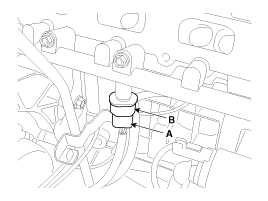
Disconnect the rail pressure sensor connector (A), and then remove
the sensor (B) from the delivery pipe.
|
Installation
|
| 1. |
Install in the reverse order of removal.
|
 Rail Pressure Sensor (RPS). Schematic Diagrams
Circuit Diagram ...
 Accelerator Position Sensor (APS). Description and Operation
Description Accelerator Position Sensor (APS) is installed on the accelerator pedal module and detects the rotation angle of the accelerator pedal. The APS is one of the most important sensors in engine ...
See also:
Repair procedures
Replacement • Be careful not to damage the fender and body. • When removing the clips, use a clip remover. 1. Remove the head lamps. 2. Remove the side sill molding. 3. Loosen the front wheel guard ...
Engine start/stop button position
OFF White With automatic transaxle To turn off the engine (START/RUN position) or vehicle power (ON position), press the engine start/stop button with the shift lever in the P (Park) position. When you ...
Sunvisor. Components and Components Location
Component Location 1. Sunvisor 2. Retainer ...
