
 Hyundai Santa Fe: Cylinder Head Cover. Repair procedures
Removal
| 1. |
Disconnect the battery negative terminal.
|
| 2. |
Remove the engine cover.
|
| 3. |
Remove the air duct and air cleaner assembly.
|
| 4. |
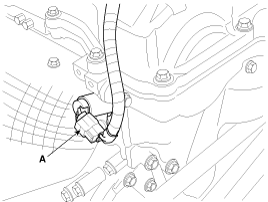
Disconnect the exhaust OCV (Oil control valve) connector
(A).
|
| 5. |
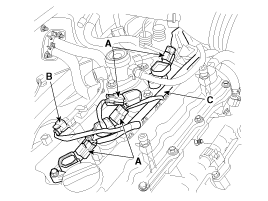
Disconnect the ignition coil connectors (A) and the
fuel pump connector (B), then remove the wiring protector (C).
|
| 6. |
Remove the ignition coils.
|
| 7. |
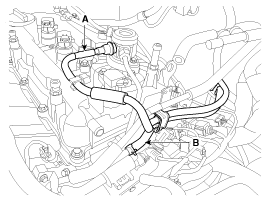
Disconnect the fuel hose (A) and PCSV (Purge control
solenoid valve) hose (B).
|
| 8. |
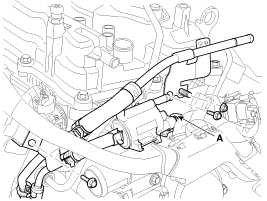
Disconnect PCSV (Purge control solenoid valve) connector
(A) and loosen the vacuum & PCSV (Purge control solenoid valve) pipe
assembly mounting bolts and nut.
|
| 9. |
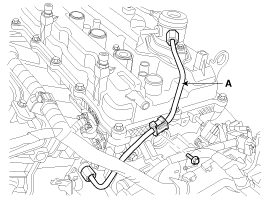
Remove the high pressure pipe (A).
|
| 10. |
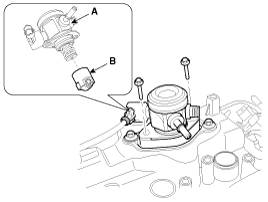
Remove the high pressure fuel pump (A) and the roller
tappet (B).
|
| 11. |
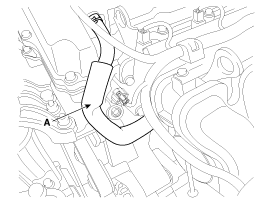
Disconnect the PCV (Positive crankcase ventilation)
hose (A).
|
| 12. |
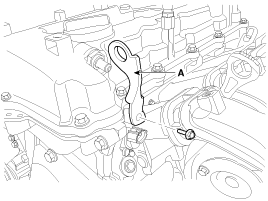
Remove the front engine hanger (A).
|
| 13. |
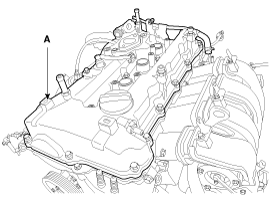
Remove the cylinder head cover (A).
|
Installation
| 1. |
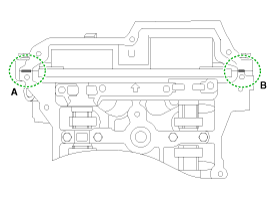
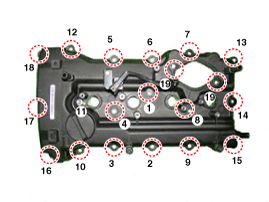
Install cylinder head cover.
|

| 2. |
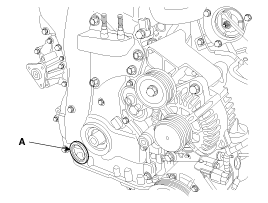
Install the front engine hanger (A).
|
| 3. |
Connect the PCV (Positive crankcase ventilation)
hose (A).
|
| 4. |
Install the high pressure fuel pump.
|
| 5. |
Install the high pressure pipe (A).
|

| 6. |
Connect PCSV (Purge control solenoid valve) connector
(A) and tighten the vacuum & PCSV (Purge control solenoid valve) pipe
assembly mounting bolts and nut.
|
| 7. |
Connect the fuel hose (A) and PCSV (Purge control
solenoid valve) hose (B).
|
| 8. |
Install the ignition coils.
|
| 9. |
Connect the ignition coil connectors (A) and fuel
pump connector (B) after installing the wiring protector (C).
|
| 10. |
Connect the exhaust OCV (Oil control valve) connector
(A).
|
| 11. |
Install the air cleaner assembly.
|
| 12. |
Install the engine cover.
|
 Cylinder Head Cover. Components and Components Location
Components 1. Cylinder head cover 2. Gasket ...
 CVVT & Camshaft. Components and Components Location
Components 1. Camshaft bearing cap 2. Camshaft front bearing cap 3. Exhaust camshaft 4. Intake camshaft 5. Exhaust CVVT assembly 6. Intake CVVT assembly 7. Exhaust camshaft upper bearing 8. Intake camshaft ...
See also:
Front Seat Shield Outer Cover. Repair procedures
Replacement • Put on gloves to protect your hands. • When prying with a flat-tip screwdriver, wrap it with protective tape, and apply protective tape around the related parts, to prevent damage. • ...
Timing Chain Cover. Repair procedures
Removal • Use fender covers to avoid damaging painted surfaces. • To avoid damage, unplug the wiring connectors carefully while holding the connector portion. Mark all wiring and hoses to avoid misconnection. ...
Floor Console Assembly. Components and Components Location
Component Location [Console rear complete assembly] 1. Console rear complete assembly [Console front complete assembly] 1. Console front complete assembly ...
