
 Hyundai Santa Fe: Engine Coolant Temperature Sensor (ECTS). Repair procedures
Inspection
| 1. |
Turn the ignition switch OFF.
|
| 2. |
Remove the ECTS (Refer to "Removal").
|
| 3. |
After immersing the thermistor of the sensor into engine coolant,
measure resistance between the ECTS terminals 3 and 4.
|
| 4. |
Check that the resistance is within the specification.
|
Removal
| 1. |
Turn the ignition switch OFF and disconnect the battery negative
(-) cable.
|
| 2. |
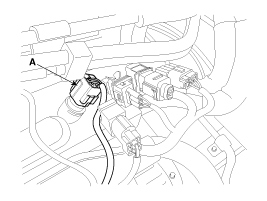
Disconnect the engine coolant temperature sensor connector (A).
|
| 3. |
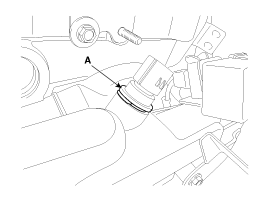
Remove the spring clip (A), and then pull the sensor from the
water temperature control assembly.
|

| 4. |
Supplement the engine coolant.
(Refer to Engine Mechanical System - "Coolant")
|
Installation
|
|
|
| 1. |
Install in the reverse order of removal.
|
 Engine Coolant Temperature Sensor (ECTS). Schematic Diagrams
Circuit Diagram ...
 Crankshaft Position Sensor (CKPS). Description and Operation
Description Crankshaft Position Sensor (CKPS) detects the crankshaft position and is one of the most important sensors of the If there is no CKPS signal input, the engine may stop because of CKPS signal ...
See also:
Transaxle ranges
The indicator lights in the instrument cluster displays the shift lever position when the ignition switch is in the ON position. P (Park) Always come to a complete stop before shifting into P (Park). This ...
Condition and operation in the front passenger occupant classification system
*1) The system judges a person of adult size as an adult. When a smaller adult sits in the front passenger seat, the system may recognize him/her as a child depending on his/her physique and posture. ...
Room lamp
Type A Type B Press the button to turn the light on or off. CAUTION Do not leave the lamp switches on for an extended period of time when the vehicle is not running because the battery may drain. ...
