
 Hyundai Santa Fe: Towing
Towing
If the vehicle needs to be towed, call a professional towing service.
Never tow vehicle with just a rope or chain. It is very dangerous.
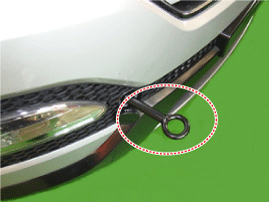
[Front]
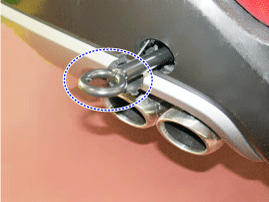
[Rear]
Emergency Towing
There are three popular methods of towing a vehicle :
| - |
The operator loads the vehicle on the back of truck. This is best
way of transporting the vehicle.
|
| - |
The tow truck uses two pivoting arms that go under the tires of
the driving axle and lift them off the ground. The other two wheels
remain on the ground.
|
| - |
The tow truck uses metal cables with hooks on the ends. These
hooks go around parts of the frame or suspension, and the cables lift
that end of the vehicle off the ground. The vehicle's suspension and
body can be seriously damaged if this method of towing is attempted.
|
If the vehicle cannot be transported by flat-bed, should be towed with
the wheels of the driving axle off the ground and do the following :
Manual Transaxle
| • |
Release the parking brake.
|
| • |
Shift the Transaxle to neutral
|
Automatic Transaxle
| • |
Release the parking brake.
|
| • |
Start the engine.
|
| • |
Shift to [D] position, then [N] position.
|
| • |
Turn off the engine.
|
|

 Lift And Support Points
Lift And Support Points When heavy rear components such as suspension, fuel tank, spare tire, tailgate and trunk lid are to be removed, place additional weight in the luggage area before hoisting. When ...
 General Tightening Torque Table
General Tightening Torque Table Bolt nominal diameter (mm) Pitch (mm) Torque Nm (kg.cm, lb.ft) Head Mark 4 Head Mark 7 M5 0.8 3 ~ 4 (30 ~ 40, 2.2 ~ 2.9) 5 ~ 6 (50 ~ 60, 3.6 ~ 4.3) M6 1.0 5 ~ 6 (50 ~ 50, ...
See also:
Outside Rear View Components and Components Location
Component Location 1. Outside rear view mirror ...
OFF mode
Push the OFF button to turn off the air climate control system. However, you can still operate the mode and air intake buttons as long as the ignition switch is in the ON position. ...
Piston and Connecting Rod. Components and Components Location
Components 1. Piston ring 2. Snap ring 3. Piston 4. Connecting rod 5. Connecting rod upper bearing 6. Connecting rod lower bearing 7. Connecting rod bearing cap ...
