
 Hyundai Santa Fe: Exhaust Manifold. Repair procedures
Removal and Installation
| 1. |
Remove the engine cover.
|
| 2. |
Disconnect the battery negative terminal.
|
| 3. |
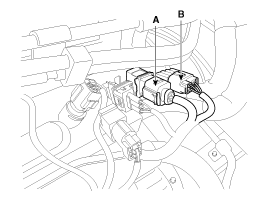
Disconnect the front oxygen sensor connector (A)
and the rear oxygen sensor connector (B).
|
| 4. |
Remove the front muffler.
|
| 5. |
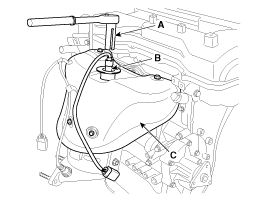
Using the SST (09392-2H100) (A), remove the front
oxygen sensor (B) and the remove the exhaust manifold heat protector
(C).
|
| 6. |
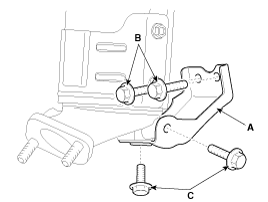
Remove the exhaust manifold stay (A).
|
| 7. |
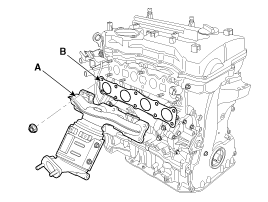
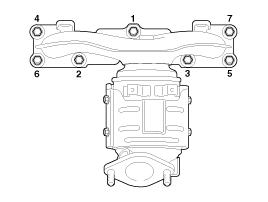
Remove the exhaust manifold (A) with the gasket (B).
When installing the intake manifold, tighten the
nuts with pre-torque first, and then tighten the nuts with specified
torque in the sequence shown.
|

| 8. |
Install in the reverse order of removal.
|
 Exhaust Manifold. Components and Components Location
Components 1. Heat protector 2. Exhaust manifold 3. Exhaust manifold gasket 4. Exhaust manifold stay ...
 Muffler. Components and Components Location
Components 1. Front muffler 2. Catalytic converter 3. Center muffler 4. Main muffler ...
See also:
Front Seat Back Cover. Repair procedures
Replacement • Put on gloves to protect your hands. • When prying with a flat-tip screwdriver, wrap it with protective tape, and apply protective tape around the related parts, to prevent damage. • ...
Gauges
Speedometer Type A Type B The speedometer indicates the speed of the vehicle and is calibrated in miles per hour (mph) and/or kilometers per hour (km/h). Tachometer Type A Type B The tachometer indicates ...
Seatback angle
To recline the seatback: 1. Pull up the seatback recline lever. 2. Hold the lever and adjust the seatback of the seat to the position you desire. 3. Release the lever and make sure the seatback is locked ...
